HERNE WINDMILL
In
Short
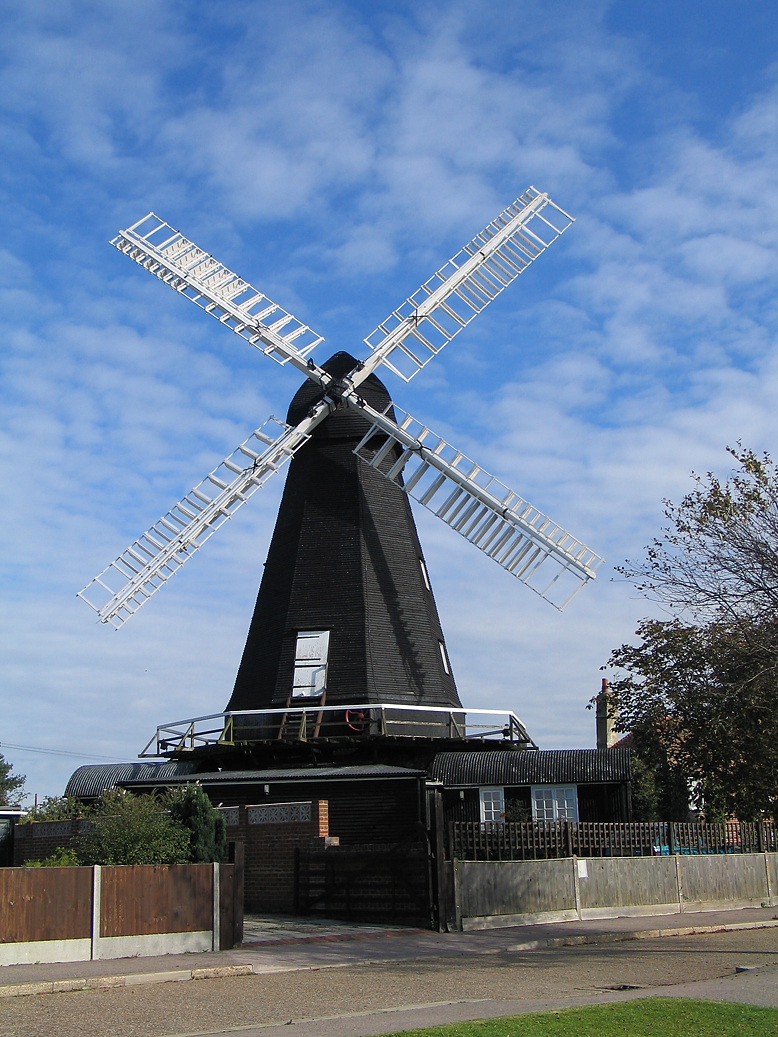
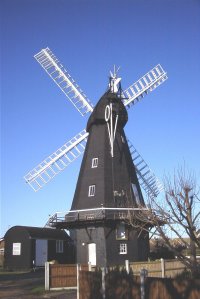
Herne Windmill stands on a site that has had a mill for 600 years
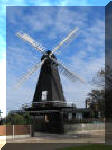
according to ancient Canterbury and County records. This relatively recent traditional Kentish *Smock Mill stands on a high down overlooking the village of
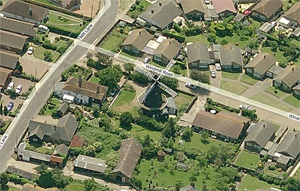
Herne and its playing field, the 'Cherry Orchard', on the outskirts of the seaside town of Herne Bay, in Kent.
(*The name smock mill comes from the
appearance of the mill (from a distance) resembling a peasant wearing a smock.
Tower mills, like Herne Mill, have the cap (the shape like an unturned boat on
the top) rotate on a solid
base; the other type of mill, a Post Mill, has the whole mill rotating around a
central post.) 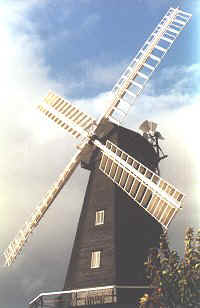
Herne Mill is equipped with three pairs of millstones: two
pairs of French Burrs and a pair of Derbyshire Peak Stones. The refurbished
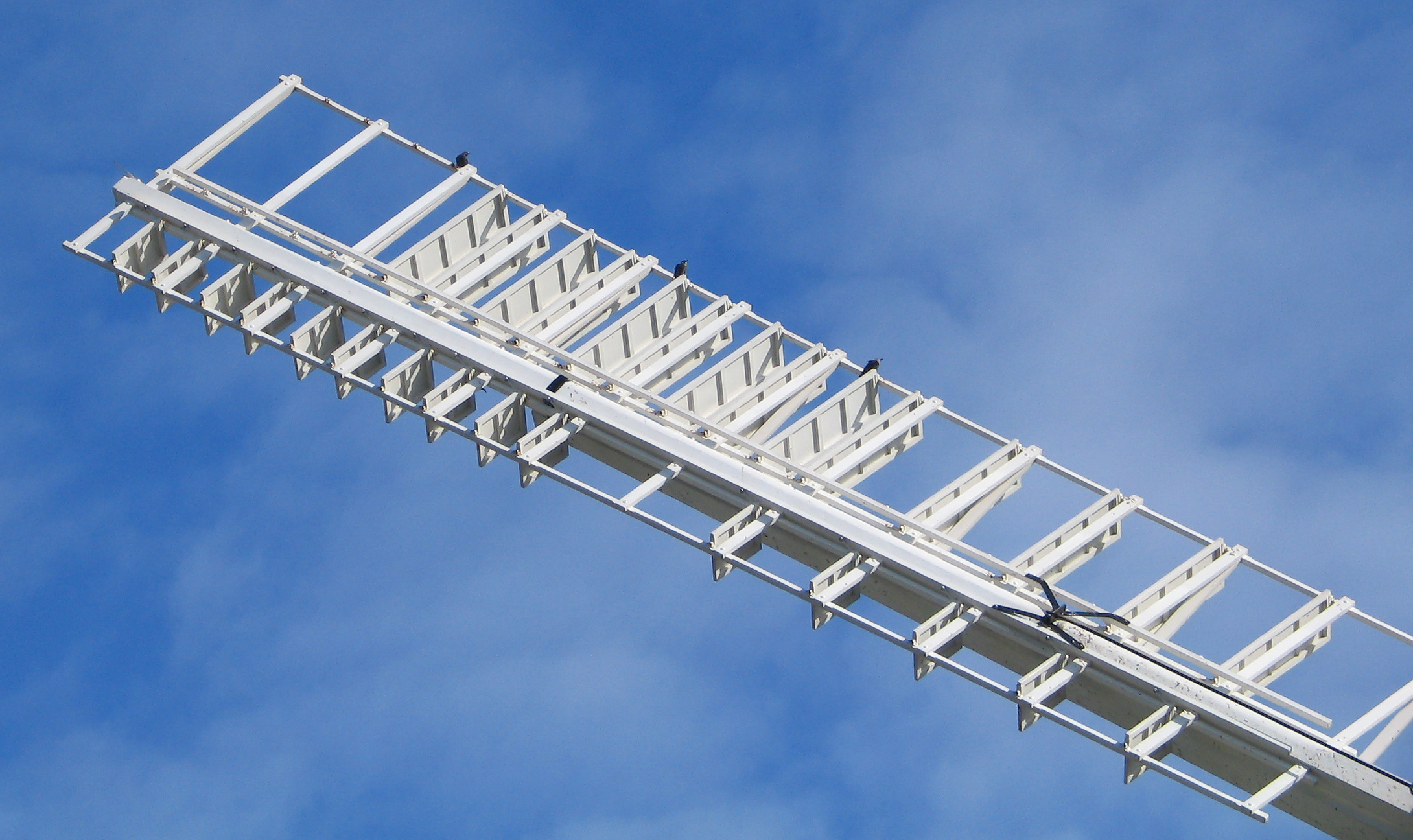
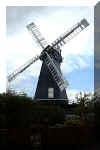
sweeps (or sails) shown in the image here have only half the number of shutters
of the original mill. In case you wondered, the sails turn anti-clockwise and it's
surprisingly quiet inside the mill when the brake is off and the sweeps are
turning.
A Quick History of Herne Mill
The present windmill has been in place since 1789 (when France had its
Revolution) and was built by the miller Job Lawrance. The mill remained in the
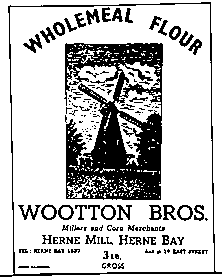
Lawrance family for a century until 1879 when it was bought by one Thomas Wootton. It was still
used for milling of cereal grains until the turn of the 19th century.
The Wootton family continued its ownership, milling animal feed by wind power until
1952, then by electricity with a flail mill until 1980.
The windmill mill is now owned by
Kent County Council and run by the Friends of Herne Mill.
For more go to
http://www.herne-mill.btik.com/p_About_Us.ikml
The Friends of Herne Mill
Much more information on the mill is published in the small
booklets ("A Guide to Herne Mill" by Tony Jarvis and "Herne
Mill a Technical Description" by David Bean) that should
be available from the
mill shop. Annual membership of the 'Friends of Herne Mill' entitles all members to free visits and copies of "Gleanings"
the occasional Mill Newsletter.
The Mill in 2001
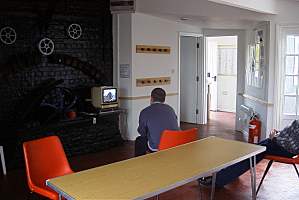
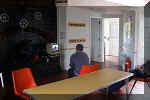
During the summer of 2000, the 'Friends of Herne Mill' had built a small
extension which they called the Wootton Room (after the brothers Clive and Edwin who
last worked the mill in 1980). The mill now has a proper visitor centre, office, shop, kitchen and toilets. The addition serves as a Parish Council office as well.
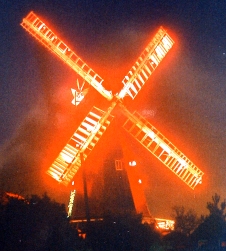
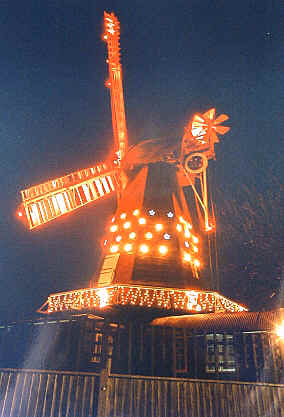
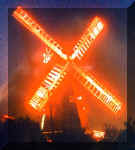
(It is also available for rent to the public.) Permanent floodlights
have been installed replacing those hired at Christmas times in the past.
 In addition to the extension, Herne Mill had the millwrights
working in the summer
of 2001 fixing a few things that weren't quite right
(shutters, curb teeth and skid bars) and the whole of the
structure, except the sweeps, had a couple of nice coats of coal tar. And smelly
(in a nice aromatic way) it was
too! In addition to the extension, Herne Mill had the millwrights
working in the summer
of 2001 fixing a few things that weren't quite right
(shutters, curb teeth and skid bars) and the whole of the
structure, except the sweeps, had a couple of nice coats of coal tar. And smelly
(in a nice aromatic way) it was
too!
In
1999, after being open for only a short
time and being refurbished, the mill received 920 visitors! In 2001 the number
of guests sailed past the 1000 mark and hit 1231 by the close of the mill to the
public on 30th September.
The mill's new facilities now gave it the ability to handle school parties
who are more than eager to scramble up and down the four flights of stairs;
school parties
receive free entry. The mill looked forward to a grand future in 2002 and onward as a living
museum and one of Herne Bay's main attractions!
Sad Days
In 2003 and after a fantastic year in 2002 (1536
visitors) it was all doom and
gloom for the 2003 season. The mill lost its sails early in the year for repair and,
although I believe promises were made to have them back for the summer of that
year, by
September the poor mill remained naked.
Happy Days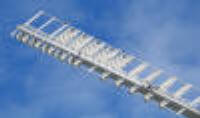
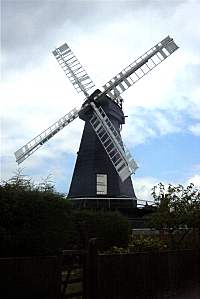
The sweeps never made it back in 2003 but were re-installed in
late Spring 2004 and all now seems to be well. The mill is sporting new,
different sweeps. Compare the pattern of new shutters with the old ones which
had shutters closer to the tips of the sails. (Click on the image, left.
2010
The Mill is under internal
refurbishment this year and shutters are due to be replaced. The
Mill therefore will not be open until June 2010, maybe later still.
Perhaps I'll get to visit this year if I ever get round to
it...
Opening Times
 I believe Herne Mill is open on afternoons on Sundays and Bank Holidays
(2pm-5pm) from Easter to the
end of September and on Thursdays during August. I believe Herne Mill is open on afternoons on Sundays and Bank Holidays
(2pm-5pm) from Easter to the
end of September and on Thursdays during August.
The entrance fee is £1 per adult
with accompanied children at 25p. A guided tour of the mill is given
by the Friends of Herne Mill as you climb the steep stairways to the cap. Most interesting, I'd say.
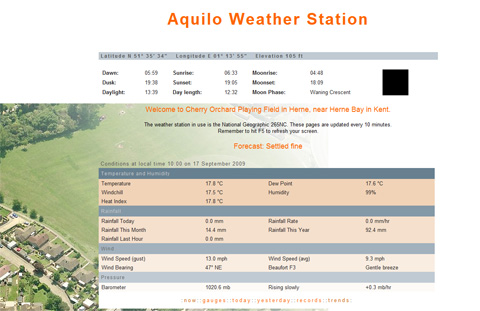
Check the
weather if you plan a visit by clicking the image below for
AQUILO WEATHER
STATION & CHERRY
ORCHARD WEBCAM
Click on thumbnails for a larger image
|
|
|
|
|
|
|
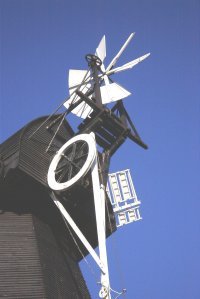
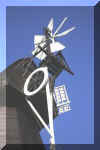
Close up of the Fantail |
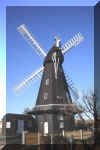
View from the rear |
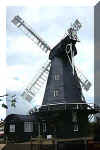
June 2001 |
Newly painted with coal tar |
|
|
 |
 |
Wootton Room
& Visitor Centre |
Special Effect |
Ooh! The lights
Christmas 2001 |
October 2004 |
|